In these posts, with the author’s permission, we look at their work pre-editing and post-editing—and at what I did to improve the piece.

The second book is tentatively titled To Find A Life and not, Jim assures me, Mo’2Moe.
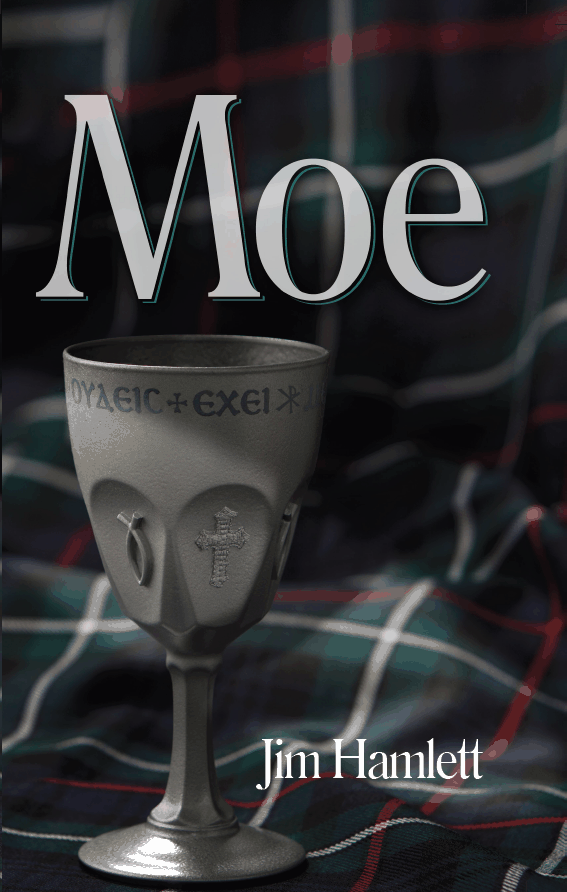
Jim has a great character in Moe, as you know if you’ve read the book. This is a character who could live on in book after book. You care about him—and not just because he’s a dwarf (of the medical kind, not the Tolkien kind).
Jim’s edit
In this short 350-word sample it’s hard to get a sense of where the story is going, but the opening interested me enough that I’d want to read more. In my edit, I addressed three issues:
- Repeated information
- Sentence construction, and
- Unnecessary details/Backstory
See my edit with Track Changes.
I get it, I get it
Sometimes writers worry the reader won’t get it—so they explain. There’s a little of that here. Since it occurs in the first graf, which you want to be a grabber, I trimmed it.
In the opening, Jim starts out great: A rumbling cannonade of thunder reached through Moses Mackenzie’s open window and snatched him from his dream. Great word picture! But then right after, he writes: With a jerk, Moe awoke. Really? Isn’t that what “snatched him from his dream” tells us, only with better words? Later at the end of the graf, Jim repeats the information that the window was open.
Best, which way is?
The construction of a sentence has much to do with a writer’s voice, so I tend to tread lightly here. But things do happen chronologically, unless you’re writing time travel. That’s why in the first graf I suggest rearranging the second sentence.
But sentence placement is often just as important, if not more so, than sentence construction. Your strongest sentences, as a guideline, should appear at either the beginning or the end of a paragraph. In Jim’s third paragraph, I thought the sentence “Few people understood how soothing a storm could be” was better used at the end of the graf than buried near the beginning. Why? Because it provides insight into who Moe is and I don’t want the reader to skip it.
Do I need to know that?
It’s a fine line. When do the details add to the story rather than distract? It’s fair to say this varies with the reader, but some things to bear in mind are the context, how obvious the information is, and whether it’s truly extraneous. Let’s look at one sentence to illustrate all three: Moe glanced at his bedside clock and read 4:07 in pale green digits.
- Context: The setting for this scene is Moe’s bedroom. Therefore, we can do away with saying his clock is “bedside.”
- Obviousness: If a character glances at a clock it’s a fair bet that character is going to read it.
- Extraneous: Knowing that the clock has pale green numbers rather than amber or blue adds nothing critical either to the story or the setting.
A word about backstory: Paragraph three seemed out of place as written. It fit with what was happening just fine, but it read like backstory—which, of course, you want to avoid early in a novel. So I reworked it to try and get it more into Moe’s POV.
 See my edited version without Track Changes.
Jim, thanks for coming Into The Edit with me! (Learn about Moe.)
If you would like to see your writing in a future In The Edit post, send a maximum of 350 words to michael.ehret (at) inbox (dot) com. Please send in Word format (.doc). If I use it, you’ll be eligible for a 10-percent discount on any editing services.
On Thursday, we’ll look at another self-editing writing tip. See you then! Then on Saturday, drop by for a quick writer’s quote and to share what that quote means to you.
 Michael Ehret, for Writing On The Fine Line


 Writing On The Fine Line
Leave a reply to Jim Hamlett Cancel reply